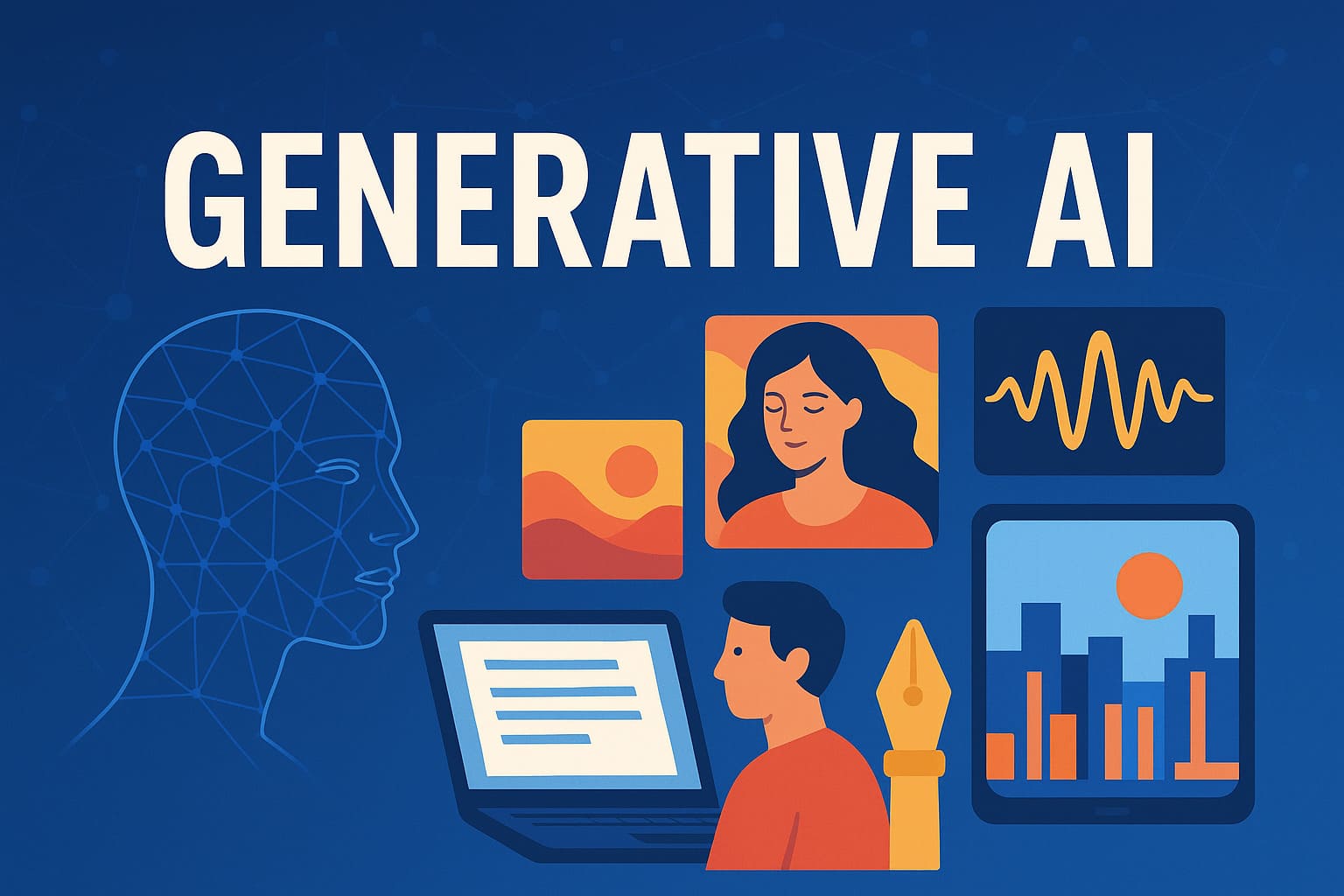
In the past few years, few technologies have captured the world’s imagination like Generative Artificial Intelligence (Generative AI). From realistic art and music creation to sophisticated text, code, and video generation, generative AI is redefining how we create, communicate, and innovate. What was once the exclusive domain of artists, writers, and designers is now being enhanced—and sometimes reimagined—by intelligent algorithms capable of generating entirely new content.
But what exactly is generative AI, how does it work, and why is it transforming industries at such a rapid pace? Let’s explore the landscape of generative AI, its underlying technologies, its practical applications, and the ethical challenges it presents.
What Is Generative AI?
At its core, Generative AI refers to a category of artificial intelligence systems that can generate new data—such as text, images, audio, code, or video—that resembles human-created content. Unlike traditional AI models that focus on classification or prediction, generative AI models create. They learn patterns from massive datasets and then use that knowledge to produce original content.
The most famous examples include ChatGPT for text generation, DALL·E and Midjourney for image generation, Suno AI for music, and Runway for video. These systems are built using deep learning architectures, particularly transformers and diffusion models, which have revolutionized AI’s ability to understand and mimic human creativity.
How Does Generative AI Work?
Generative AI models are typically trained on enormous datasets that contain examples of the type of content they’re expected to produce. During training, the model learns complex relationships between elements in the data—such as how words relate to each other in a sentence or how colors and shapes combine in an image.
Two of the most important technologies behind generative AI are:
-
Generative Adversarial Networks (GANs) – Introduced in 2014 by Ian Goodfellow, GANs consist of two neural networks: a generator that creates data and a discriminator that evaluates it. The generator tries to produce outputs that look real, while the discriminator tries to distinguish between real and generated data. Over time, both networks improve until the generated content becomes almost indistinguishable from reality.
-
Transformers and Large Language Models (LLMs) – Popularized by models like OpenAI’s GPT (Generative Pre-trained Transformer) and Google’s BERT, transformers are the backbone of most text-based AI systems. They use “attention mechanisms” to understand the relationships between words across long contexts, enabling them to generate coherent, contextually relevant, and human-like language.
Recent advancements, such as diffusion models (used in Stable Diffusion and DALL·E 3), have taken things further by enabling highly detailed image and video generation through iterative noise reduction.
Applications of Generative AI Across Industries
Generative AI is no longer a laboratory experiment—it’s now integrated into a wide range of industries and workflows.
1. Content Creation and Marketing
Marketers use tools like Jasper AI and ChatGPT to draft blog posts, ads, and social media captions in seconds. Generative AI also helps create personalized marketing campaigns by analyzing audience data and tailoring messages accordingly.
2. Design and Art
Artists, designers, and filmmakers leverage AI tools such as Midjourney, Adobe Firefly, and Runway to create concept art, visual effects, and even fashion designs. These tools serve as creative partners, allowing professionals to rapidly prototype ideas that might have taken days or weeks to produce manually.
3. Software Development
Developers now have access to AI coding assistants like GitHub Copilot, Tabnine, and Replit’s Ghostwriter, which can generate code snippets, debug errors, and even build entire software modules. This accelerates the development cycle and reduces the burden of repetitive coding tasks.
4. Education
Generative AI is transforming education by personalizing learning materials, generating quizzes, summarizing academic papers, and providing tutoring through conversational agents. Teachers can also use AI to create lesson plans or simplify complex topics for different grade levels.
5. Healthcare
In medicine, generative AI is helping to design new drugs, simulate molecular interactions, and even generate synthetic patient data for research—while preserving privacy. AI models can also draft medical reports, summarize research findings, and assist with patient communication.
6. Entertainment and Media
In the entertainment industry, AI-generated scripts, music compositions, and virtual characters are becoming mainstream. Video game developers are exploring generative AI to create dynamic, evolving worlds and storylines that adapt to player behavior.
Benefits of Generative AI
Generative AI’s rise offers numerous advantages that extend beyond efficiency:
-
Creativity Amplification: Rather than replacing human creativity, AI enhances it—helping people explore new ideas, styles, and perspectives faster.
-
Cost and Time Efficiency: Businesses can automate repetitive creative tasks, reducing costs and speeding up production cycles.
-
Accessibility: AI tools democratize creativity by allowing non-experts to generate professional-quality content, from artwork to music to code.
-
Personalization: Generative AI can tailor content—ads, learning materials, entertainment—to individual preferences, making experiences more relevant and engaging.
Challenges and Ethical Considerations
Despite its promise, generative AI poses serious challenges that need to be addressed responsibly.
1. Misinformation and Deepfakes
AI can generate highly realistic fake images, videos, and news stories, blurring the line between truth and fiction. This has major implications for politics, journalism, and public trust.
2. Intellectual Property
Since generative models are trained on existing data, questions arise about copyright and ownership. Should AI-generated art belong to the creator, the AI company, or the original data sources?
3. Bias and Fairness
Generative AI systems can inadvertently reproduce or amplify biases present in their training data, leading to discriminatory or offensive outputs. Continuous monitoring and diverse data collection are critical to mitigating this issue.
4. Job Displacement
Automation in creative and administrative fields could lead to job restructuring or losses. However, it’s also creating new roles—AI trainers, ethicists, and prompt engineers—that didn’t exist before.
5. Data Privacy
Training AI on user-generated content raises questions about consent and privacy. Transparent data practices are essential for building public trust.
The Future of Generative AI
As generative AI continues to evolve, we’re entering a new era of collaborative creativity. Future models will likely be more multimodal—able to understand and generate across text, image, audio, and video simultaneously. They’ll integrate more deeply into everyday tools, becoming silent partners in our creative and analytical workflows.
In business, generative AI will underpin hyper-personalized customer experiences, AI-driven product design, and adaptive marketing. In education and science, it will accelerate discovery and make complex knowledge more accessible. And in society, it will challenge our notions of authorship, authenticity, and creativity itself.
Conclusion
Generative AI represents one of the most transformative technological revolutions of our time. It blurs the line between human and machine creativity, offering unprecedented opportunities for innovation, productivity, and artistic expression. Yet, it also demands thoughtful governance to ensure that progress aligns with ethics, fairness, and truth.
In the coming years, the winners in this new AI era will not be those who resist change—but those who learn to collaborate with it. Generative AI is not replacing human imagination; it’s amplifying it. And in doing so, it’s helping us reimagine what’s possible.
#GenerativeAI #ArtificialIntelligence #AIFuture #MachineLearning #AIInnovation #TechTrends #AICreativity #AIinBusiness #DigitalTransformation #DeepLearning #AIRevolution #AIContent #FutureofWork