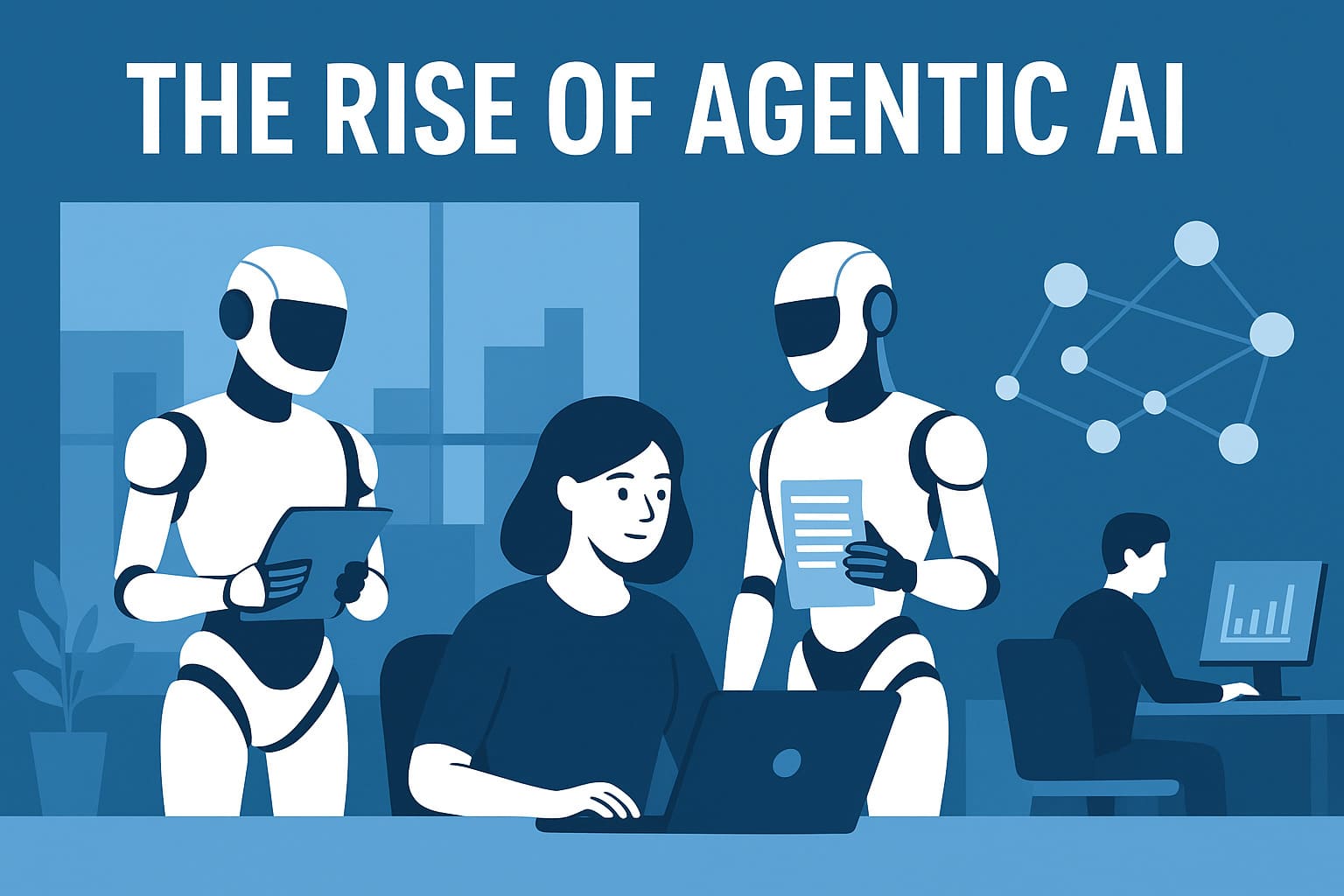
Artificial Intelligence (AI) is no longer just about chatbots or tools that respond to prompts. As we move deeper into 2025, a new paradigm is gaining momentum — one in which AI systems act more autonomously, make decisions, coordinate amongst themselves, and execute tasks without constant human supervision. This is often referred to as agentic AI.
In this blog, we’ll explore what agentic AI is, why it matters now, where it’s headed, what challenges lie ahead, and what it means for businesses and individuals.
What is Agentic AI?
At its core, agentic AI refers to AI systems (or “agents”) that can set goals, plan, act, and adapt — sometimes coordinating with other agents or systems to execute higher-level tasks. It goes beyond traditional AI tools that simply respond to user input. According to a recent article:
“Agentic AI seems to be on an inevitable rise… autonomous and collaborative AI programs will be primarily based on focused generative AI bots that will perform specific tasks.”
Some key characteristics:
-
They can operate independently of direct human prompting (after initial setup).
-
They may coordinate with other agents or systems to complete a workflow (e.g., one agent schedules, another executes, a third reports).
-
They often operate in a multimodal fashion (text, images, data, actions) and may carry out end-to-end tasks.
-
They are increasingly embedded within enterprise systems, not just as standalone apps.
One report put it this way:
Agentic AI “autonomously complete tasks on behalf of humans … they can set goals, make decisions and handle open-ended, complex projects.”
Why 2025 is the Year of Agentic AI
Several converging trends are making agentic AI more feasible and important now.
1. From experiment to optimization
Many companies moved from generative AI pilots to full production deployments. According to a major cloud provider’s blog:
“2025 will be the year of optimization. Companies will begin to shift their focus from simply experimenting with or implementing AI to optimizing its performance and maximizing its value.”
This means systems are maturing; now the next step is putting them into more autonomous roles.
2. Rise of unstructured / multimodal data
The explosion in data types (text, images, video, sensor data) means AI systems need to operate across domains. According to MIT Sloan Review:
“The great majority of the data that GenAI works with is relatively unstructured … a leader at one large insurance organization recently shared … 97% of the company’s data was unstructured.”
Agentic AI thrives when it can pull in diverse data, infer actions, and respond — not just answer queries.
3. Corporate appetite and investment
Reports show that enterprises expect meaningful return on investment from generative/agentic AI. Also, major technology vendors have flagged “agentic AI” as a top trend for 2025.
4. Demand for workforce productivity and automation
Firms are looking to offload repetitive work, streamline workflows, and combine AI with automation. Reports show generative AI is being used more for content, code, summarization — the logical next step? Let the agent handle it end-to-end.
What Agentic AI Could Look Like in Practice
Here are some concrete possibilities:
-
Workflow Automation Agents: An enterprise agent could monitor incoming customer support tickets, classify them, escalate to appropriate teams, draft responses, and follow-up on resolution — with minimal human oversight.
-
Multimodal Assistants: Suppose an agent can ingest meeting transcripts (text), video recordings (visual), and email threads (data) — then coordinate tasks, send follow-up reminders, and schedule next steps autonomously.
-
In Domain Agents for Specialists: In healthcare, an agent could monitor patient data streams, detect anomalies, trigger alerts, request further tests, and coordinate with human clinicians.
-
Coordination of Multiple Agents: A “master agent” orchestrates specialized sub-agents (e.g., procurement agent, logistics agent, compliance agent) to execute complex projects.
-
Smart Devices / IoT Integration: In smart homes or factories, agentic AI could manage device fleets, predict maintenance needs, schedule downtime, manage energy use without constant human input.
Why It Matters: Business & Societal Implications
For Businesses
-
Increased Productivity: By shifting from “tool” to “agent,” you move from asking AI to responding, to AI proactively doing. That can free humans for higher-value work.
-
Scalability: Agents can scale workflows that previously required human coordination and oversight — from HR to customer service to operations.
-
New Business Models: Entirely new service offerings can emerge — e.g., AI-agents that drive business processes for clients as a subscription.
-
Competitive Advantage: Early adopters who build agentic systems may differentiate with faster, smarter processes and lower overhead.
For Society
-
Workforce Transformation: Tasks previously done by humans may be shifted to agents. This raises both opportunities (more creative/higher value work) and risks (job displacement, skills gap).
-
Ethical & Governance Challenges: As agents act independently, questions about accountability, transparency, bias, and safety become critical.
-
Security and Trust: Autonomous agents present new attack surfaces (e.g., misuse, adversarial behavior) and demand robust governance.
-
Access & Equity: If only large companies can afford agentic AI, a new divide may emerge between AI-enabled and non-AI-enabled organisations.
What’s Holding Agentic AI Back?
Despite strong momentum, there are meaningful challenges:
1. Trust, control & alignment
Removing humans from the loop means agents must behave reliably, transparently, and align with organizational goals. MIT research emphasises:
“Every step of the process, you can use generative AI … but this is not a free lunch.”
2. Measuring Value & ROI
It’s still early days for agentic use cases. Survey data shows that while many believe value is being generated, few companies have robust metrics.
3. Data management & unstructured complexity
Agentic systems need access to richly-labelled, high-quality data — especially unstructured data — and many enterprises are still catching up.
4. Regulatory & governance concerns
As agents make decisions autonomously, issues of liability, bias, explainability, and regulation become pressing. Analysts highlight “AI governance platforms” and “disinformation security” as top trends for 2025.
5. Technical & infrastructure constraints
Building, training, deploying agentic systems requires compute, data pipelines, orchestration frameworks, monitoring — not trivial for many organisations.
How Organisations Can Prepare
Here are some actionable steps for businesses (and by extension professionals) to prepare for the rise of agentic AI:
-
Start small, think big: Experiment with pilot agents in low-risk domains (e.g., internal help desks, simple process automation) before scaling to high-impact workflows.
-
Define governance & accountability upfront: Establish who is responsible when an agent acts, how decisions are logged, how outcomes are measured.
-
Build data foundations: Invest in unstructured data pipelines, embeddings/vector databases, retrieval-augmented generation (RAG) systems — these are the backbone of effective agentic AI.
-
Measure ROI, not just hype: As one article warns — many organisations believe they’re getting value, but few have rigorous metrics. Establish baseline, success criteria, and monitor.
-
Upskill the workforce: If agents are taking over tasks, human roles shift. Focus on oversight, exception management, AI governance, and creative/strategic work.
-
Monitor ethics and risk: As autonomy grows, so do risks. Bias, fairness, transparency, security — these are not optional extras.
-
Stay aware of infrastructure & vendor lock-in: Agentic systems may tie you into specific platforms, compute frameworks, or ecosystems. Evaluate flexibility and future proofing.
The Big Picture: What Could the Future Look Like?
If we extend current trends, agentic AI may usher in a world where:
-
Many digital roles (e.g., scheduling, coordination, routine decision-making) are handled by AI agents.
-
Humans focus more on strategy, oversight, creative thinking, ethics/regulation — tasks where human judgement remains paramount.
-
Organisations increasingly act as orchestrators of agent ecosystems — building networks of sub-agents rather than single monolithic systems.
-
Governance and regulation frameworks evolve to treat agents as actors in workflows, not just tools.
-
New business models emerge: e.g., “agent-as-a-service”, where companies subscribe to domain-specific agents rather than build everything in-house.
-
Ethical and societal design becomes foundational: we ask not only what an agent can do, but should it do it, how human-centric the workflow remains, and who is accountable when things go wrong.
Why It’s Important for You (Even in Rasapūdipalem, Andhra Pradesh)
You might wonder how this global tech shift matters locally — here’s why:
-
Job market: Even in smaller towns, roles may shift from routine tasks (eligible for automation) to more oversight/creative roles. Upskilling becomes valuable.
-
Local businesses & startups: SMEs can benefit from agentic-AI by automating workflows previously accessible only to large firms — improving efficiency, reducing cost, gaining competitive edge.
-
Education & skills: Schools, colleges, training institutes need to adapt curricula: not just how to use AI tools, but how to manage and govern autonomous systems.
-
Digital divide: If only tech-rich regions adopt agentic AI, rural or underserved areas may lag further. Awareness and access matter.
-
Ethical local issues: Agents in administration, citizen services, retail — their introduction raises questions of fairness, transparency, bias that local governments and communities should anticipate.
Final Thoughts
Agentic AI is more than just the next phase of generative AI. It’s about systems that act, not just respond. As we move into the latter half of 2025 and beyond, the smart organisations will pivot from “let’s try AI” to “let’s build agents that do things”.
But with great power comes great responsibility. Autonomy in AI demands robust governance, measurement, ethical guardrails, and human-in-the-loop oversight. It also means humans must adapt: our roles, skills, and expectations will shift.
For businesses, the message is clear: Start architecting for agents now — define data strategies, governance models, pilot use cases — before the technology reaches your doorstep. For individuals, the focus is on adaptability: develop not just how to use AI, but how to supervise, collaborate with, and govern AI-agents.
In many ways, we’re at a transformative threshold. The question is not if agentic AI will matter — but how you will engage with it.
#AgenticAI #ArtificialIntelligence #AITrends2025 #GenerativeAI #Automation #AIinBusiness #FutureOfWork #AIRevolution #MachineLearning #AIAgents #DigitalTransformation #TechInnovation #AIethics #AIgovernance #SmartAutomation #AInews